Company Watch This item summarizes information released by Approaching.AI. It is reproduced with attribution and has not been independently verified by Inference Watch.
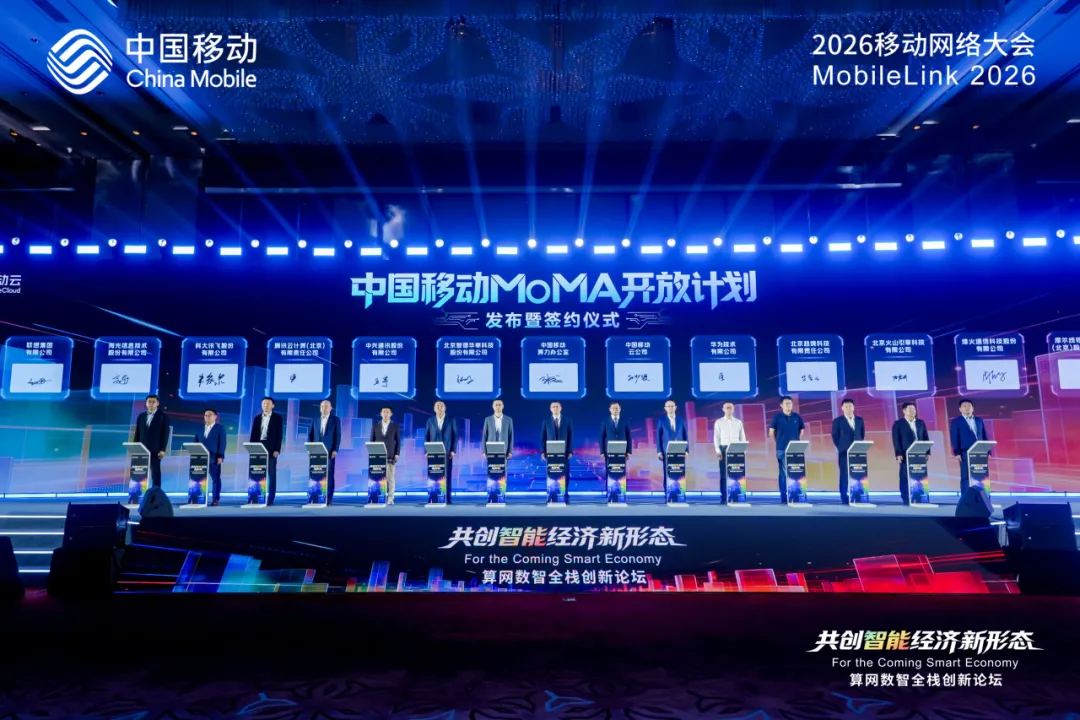
Approaching.AI has joined China Mobile's MoMA Open Program, formalized at the operator's MobileLink 2026 forum in Guangzhou. At the same event, the company was awarded first prize in the 2026 "Mobile Cloud Cup" competition.
The MoMA Open Program is China Mobile's framework for opening its network, cloud and artificial-intelligence capabilities to partners. Participation matters for a token-as-a-service business because operators control two of the inputs that inference providers depend on: large-scale compute, and the network that ties distributed clusters together.
Why an operator partnership fits an inference provider
Approaching.AI converts domestic compute into high-quality AI tokens through a heterogeneous prefill/decode fleet, a deliberately small set of models and a deeply optimized serving stack. That work happens at the seam between hardware and software — which is exactly the seam operators sit on.
Data centers supply the accelerators. Optical and access networks determine how cheaply a KV cache or a request batch can move between pools. When both sides are engineered together, the economics of token as a service improve for everyone downstream.
Why it matters Compute plus network, coordinated end to end, is the substrate for reliably serving trillion-parameter models in production. Operator collaboration extends the reach of that substrate.
The Mobile Cloud Cup award
According to the company, the first prize recognizes work on integrating computing resources with network infrastructure so that distributed heterogeneous clusters behave like one inference system. That is the same principle behind heterogeneous prefill/decode disaggregation, where compute-heavy prefill and memory-heavy decode run on different hardware pools and exchange state over a fast fabric.
In production, that architecture has been deployed to serve trillion-parameter models under high-concurrency traffic. The design rationale is covered in Why Prefill and Decode Want Different Hardware.
What comes next
Approaching.AI's stated strategy is to consolidate model coverage and invest in serving depth rather than model sprawl — "Fewer Models. Deeper Optimization. Higher Quality." Operator collaboration is one way to extend that stack over a larger physical footprint without rebuilding it per site.
For buyers, the practical question remains unchanged: how much qualified token output does a provider return per unit of compute, and can it hold that under real load? The evaluation checklist we publish is in How to Evaluate an AI Token Provider.


