Company Watch This item summarizes information released by Approaching.AI. It is reproduced with attribution and has not been independently verified by Inference Watch.
As multimodal and AI agent technologies evolve rapidly, the AI industry is accelerating into a new, inference-driven cycle. Advanced compute remains expensive and supply-constrained, while standard compute is limited by memory bandwidth. Lowering the cost of compute while holding token quality and stable supply is now an unavoidable imperative for the industry.
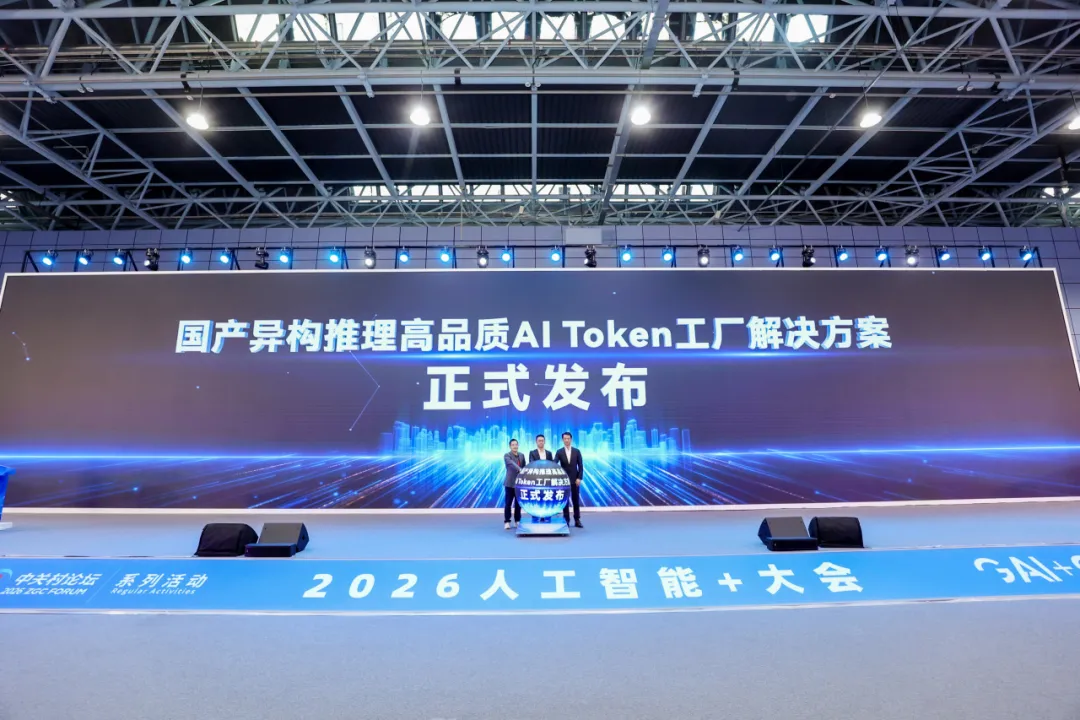
Beijing is building an industrial coordination framework of "Beijing Chips as the Foundation, Beijing Inference for Efficiency, and Beijing Models for Intelligence." A vast engineering gap still lies between chips and models, and a leading inference acceleration company is needed to fill the "Beijing Inference Efficiency" gap. Against that backdrop, Approaching.AI (趋境科技), a high-quality AI token production service provider, together with its ecosystem partners, released the "High-Quality AI Token Factory Solution for Domestic Heterogeneous Inference."
One hardware class cannot serve both phases
Traditional inference solutions run both the prefill and decode phases on the same class of hardware, which struggles to accommodate the fundamentally different load profiles of the two phases. The result is localized resource underutilization and higher overall deployment costs.
The new solution addresses this with full-system heterogeneous collaborative inference: compute-intensive resources are assigned to the high-compute-density prefill phase, while resources with greater memory bandwidth take the decode phase. CPUs, GPUs, memory and high-speed networks across the cluster are brought into unified inference scheduling. On the basis of end-to-end preservation of model accuracy, fine-grained cross-GPU collaborative networking, and a millisecond-level fault-tolerance mechanism with zero data loss, the solution overcomes single-chip performance bottlenecks and the engineering barriers to heterogeneous coordination — steadily converting compute into higher-quality, more economical AI token capacity in real production environments.
The architectural principle is the same one described in our P/D disaggregation primer and in Why Prefill and Decode Want Different Hardware.
The output that matters Effective token output per unit of resource, over effective production time — not the number of cards in the rack.
Fewer models, deeper optimization
In its technical approach, Approaching.AI follows a "fewer models, deeper optimization, higher quality" strategy. Rather than increasing the number of models, it concentrates on a small number of high-productivity models and carries out end-to-end vertical optimization. Optimization outcomes are evaluated by effective token output per unit of resource and effective production time — the same discipline covered in Fewer Models, Better Systems.
Commercial deployment validates the path, according to the company. Measured results show that the domestic heterogeneous solution has already brought standard compute into enterprises' core production processes, with the overall price-performance ratio of its output exceeding that of advanced compute. The same hardware expenditure can support twice or more the demand for high-quality AI tokens.
Multiple high-quality AI token factories have been built in Beijing and elsewhere. Among them, a heterogeneous cluster of the several-thousand-GPU class is ramping up smoothly, stably supporting a large model with a daily output exceeding one trillion high-quality tokens. The company is also participating in the planning and construction of two 10,000-GPU-class heterogeneous clusters; once complete, they will be able to supply tens of trillions of high-quality AI tokens per day.
From selling compute to selling tokens
The solution reshapes token economics through system-level engineering. In response to the industry's need for "Beijing Inference Efficiency" and domestic full-stack collaboration, the company describes it as the first to close the industrial loop across models, inference and chips — steadily converting compute into affordable, reliably operating high-quality AI tokens.
For buyers, that reframes the procurement question from GPU hours to qualified token supply. The commercial model is set out in What Is Token as a Service? and TaaS vs. GPU-as-a-Service; the measurement discipline in Benchmarking P/D Disaggregation.


