Company Watch This item summarizes information released by Approaching.AI. It is reproduced with attribution and has not been independently verified by Inference Watch.
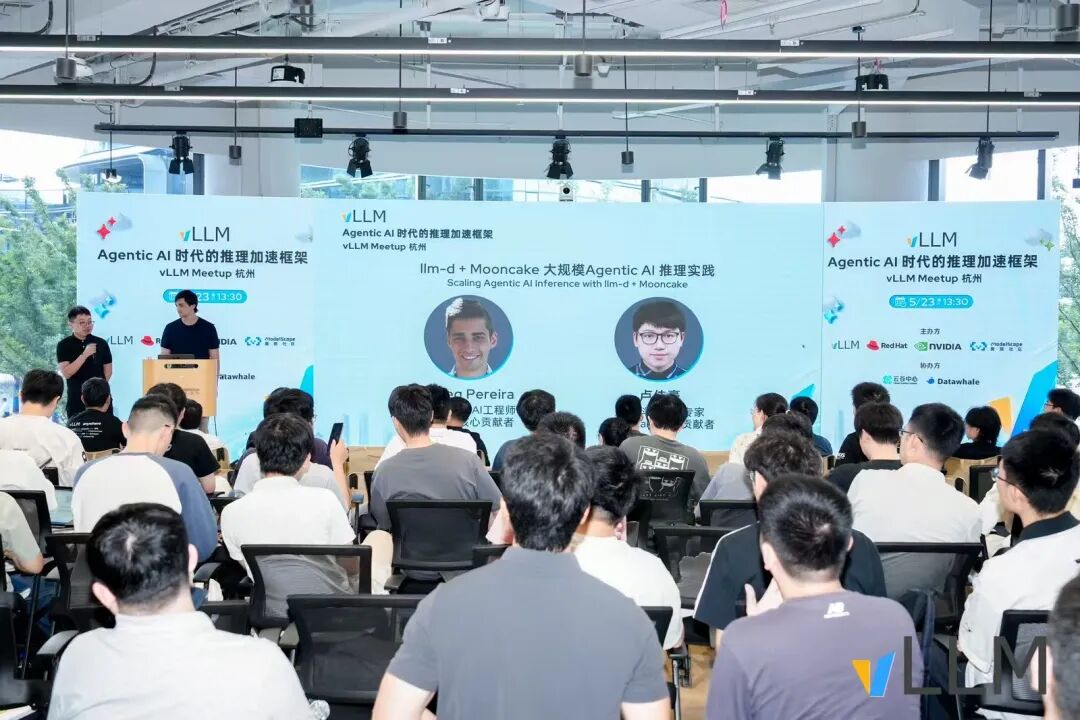
On 23 May, Approaching.AI took part in a vLLM community technical meetup in Hangzhou alongside engineers from Red Hat, NVIDIA and Moonshot AI, discussing how inference system architecture is evolving for agentic AI.
Approaching.AI's Lu Jiahao and llm-d core maintainer Greg Pereira presented jointly. According to the release, they described llm-d's technical base for combining distributed inference with Kubernetes operations, and Mooncake's "storage-for-compute" concept, which uses the TENT transfer engine and tiered storage to store and move KV cache efficiently. The two sides also disclosed a phased integration plan.
What the integration is aiming at
Agentic workloads keep context alive across many calls, so the serving system's job is increasingly to keep state close to compute and to move it cheaply when scheduling changes. Kubernetes gives operators a control plane for placement; a distributed cache layer gives the data plane something worth placing. The hard part is the seam between them.
For background on the transfer mechanics, see KV Cache Transfer in Disaggregated Serving and The KV Transfer Latency Budget.
Why it matters
Open-source integration is how serving ideas become defaults. If cache-aware scheduling lands in llm-d, the benefit reaches teams that never adopt a commercial token service — which is a different kind of competitive advantage from a proprietary platform.


