Company Watch This item summarizes information released by Approaching.AI. It is reproduced with attribution and has not been independently verified by Inference Watch.
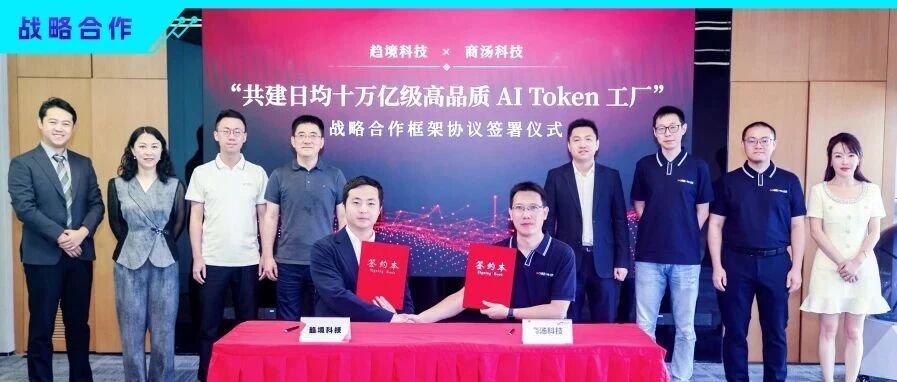
Approaching.AI and SenseTime's large AI infrastructure unit have signed a strategic cooperation agreement to jointly build a "high-quality AI Token factory" with a stated target of ten trillion tokens per day. According to the announcement, the first co-built production line is already online, with stable production and consumption capacity at the trillion-token-per-day level.
The partnership combines Approaching.AI's work on domestic chip adaptation, inference optimization and token operations with SenseTime's large-model, infrastructure and industry-application assets. The stated focus areas are heterogeneous prefill/decode coordination, KV cache transfer and reuse, and hardware-software adaptation — assigning each inference phase to the hardware best suited to it.
What the two sides say they will build
According to the release, the joint factory will expand capacity for enterprise services, agent workloads and industry-specific models. The engineering emphasis tracks the architecture this site has covered before: disaggregating compute-heavy prefill from memory-heavy decode across mixed hardware pools, and moving KV cache between them rather than recomputing it. See Heterogeneous P/D Disaggregation: A Primer and KV Cache Transfer in Disaggregated Serving.
The capacity figures — ten trillion tokens per day as a target, one trillion already online — are company statements. Independent verification would require production telemetry, workload definitions and acceptance criteria that the announcement does not provide. Buyers evaluating token supply should still test acceptance rates, TTFT stability and retry billing under their own workloads; the 12-question checklist is a starting point.
Why it matters
Partnerships between an inference operator and a model-and-infrastructure vendor are a bet that token supply is becoming an industrial process: capacity is planned, lines are commissioned, and output is measured per day. Whether that framing holds depends less on the press release than on whether the joint line can sustain quality and latency at scale — the quality bar that separates a token factory from a token meter.


